The Federal Government has reaffirmed its commitment to expanding access to quality eye care services across the country as part of ongoing efforts to reduce avoidable blindness, improve productivity and strengthen Nigeria’s health system.
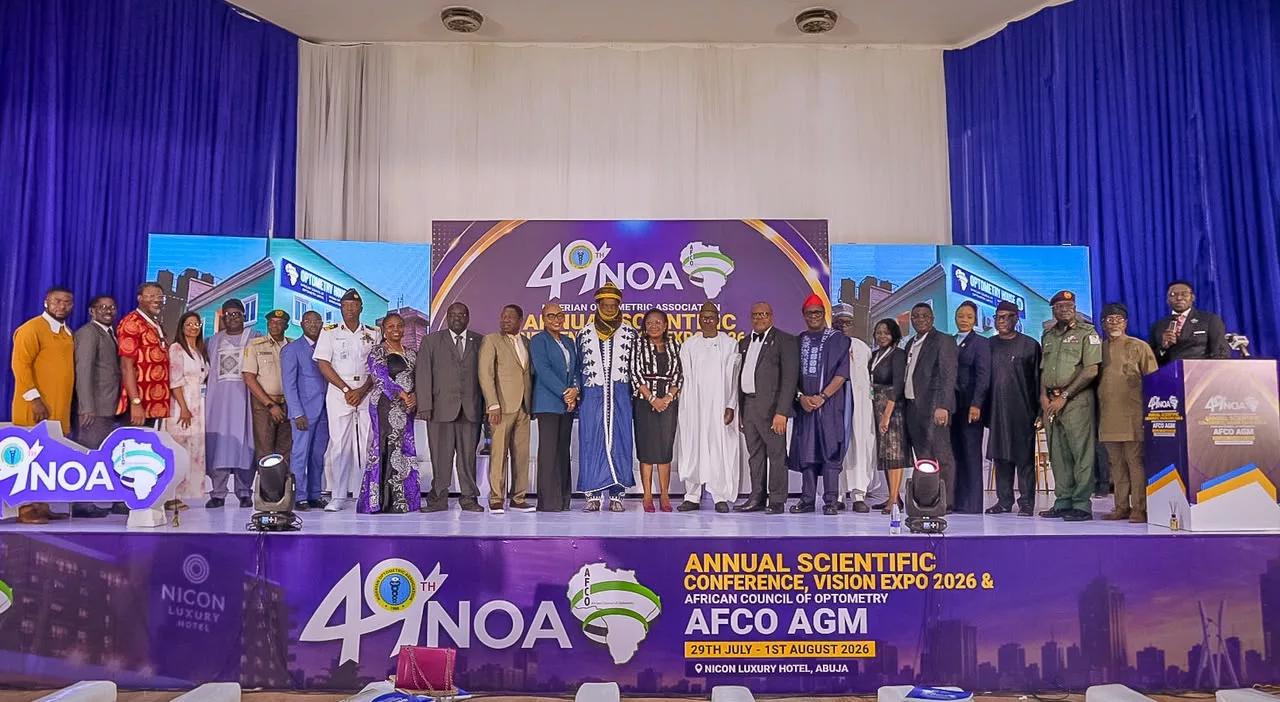
The Honourable Minister of State for Health and Social Welfare, Dr. Iziaq Adekunle Salako, stated this while declaring open the 49th Annual National Scientific Conference of the Nigerian Optometric Association (NOA) and the Annual General Meeting of the African Council of Optometry (AFCO) held on Thursday, July 30, 2026.
Speaking on the conference theme, “Optometrists in a Changing Africa: From Diversity to Unity,” the Minister described the theme as a timely call for stronger collaboration among eye care professionals across Africa to build resilient and inclusive health systems capable of addressing the continent’s growing eye health challenges.
Dr. Salako noted that eye health is no longer being treated as an afterthought under the administration of President Bola Ahmed Tinubu, GCFR, stressing that the Federal Government has prioritised primary eye care and the prevention of avoidable blindness through deliberate policies and investments.
He highlighted key achievements under the National Eye Health Strategic Development Plan (2024–2028), including the integration of eye care services across all levels of healthcare, the launch of the Nigeria Glaucoma Guidelines and Toolkit to standardise diagnosis, treatment and referral protocols, and the training of ophthalmologists from the 36 states and the Federal Capital Territory to strengthen glaucoma management nationwide.
The Minister also disclosed that under the Effective Spectacle Coverage Initiative, popularly known as Jigi-Bola 2.0, more than 2,220 Primary Health Care workers across 16 states have been trained and equipped to conduct vision screening and refer patients appropriately.
According to him, the mobile eye care programme has screened nearly two million Nigerians and provided more than 1.3 million free reading glasses, with about 66 percent of beneficiaries receiving spectacles for the first time in their lives.
He further announced that the initiative is being expanded under the Renewed Hope Health Connect Programme to deliver at least five million free spectacles and 25,000 free cataract surgeries across the country by the end of 2027.
The Minister emphasised that investments in eye care generate enormous social and economic benefits by improving educational outcomes, increasing productivity, reducing healthcare costs and promoting social inclusion.
“Studies have shown that for every 1USD invested in global eye care, there is 28 – 36 USD return through the prevention of vision loss, improved quality of life, reduced burden on the healthcare system, more productivity and so on. Enhanced eye care services is a panacea to promoting social inclusion, education, and overall well-being.” Salako revealed.
Commenting on Nigerian optometrists for their dedication and service, Dr. Salako described them as the frontline of community eye health, noting that their role remains indispensable in bridging the gap between primary screening and specialised clinical care.
He reaffirmed the Ministry’s commitment to deepening collaboration with the Nigerian Optometric Association to strengthen community-based eye care programmes, promote research and integrate optometric services more effectively into Nigeria’s healthcare system.
“As we look ahead, the Ministry remains fully committed to collaborating with the Nigerian Optometry Association to integrate these grassroots programs even deeper into our national health architecture. We want to hear your ideas, tap into your research, and lean on your expertise to make universal eye health a reality in Nigeria.” Dr. Salako appealed.
The Minister also congratulated the Nigerian Optometric Association for securing the headquarters of the African Council of Optometry in Nigeria and for producing the President-elect of the continental body, describing the achievements as significant milestones for the country’s eye care profession.
He urged optometrists to continue advancing professional excellence, mentoring younger practitioners and partnering with government to achieve universal access to quality eye care services.
Declaring the 49th Annual National Scientific Conference officially open, Dr. Salako expressed optimism that the conference would generate practical solutions for closing existing gaps in the prevention and treatment of vision loss across Nigeria and Africa.
Signed
Ado Bako
Assistant Director Director, Information and Public Relations
30 July 2026